
Zürich · Bern · Lauterbrunnen · Jungfraujoch · Lake Brienz · Lucerne
There are trips you plan, and then there are trips that plan you. Switzerland was the second kind. We went in expecting cheese, chocolate, and a few nice views. What we got was one of the most jaw-dropping two weeks of our lives — and a serious case of “why don’t we live here” that hasn’t fully gone away.
Whether you’re into mountains, history, lakes, or just wandering beautiful old streets with no agenda, Switzerland delivers. Here’s how our trip went, stop by stop.
Before You Go: Traveling to Switzerland
Switzerland sits in the heart of Europe and is one of the easiest countries to move around once you’re there. Zürich and Geneva are the main international entry points, with direct flights from major US cities. The country is not part of the EU and uses the Swiss Franc (CHF) — budget accordingly, because Switzerland is expensive. A coffee runs 6–7 CHF, and a sit-down lunch for two can easily hit 80.
The Swiss Travel Pass is worth every franc if you’re hitting multiple cities. It covers trains, buses, boats, and most mountain railways — essentially unlimited public transit across the whole country. Book it before you leave home. Trains here run on the minute, and the scenery from the rail lines alone is worth the ride.
✈ Trains in Switzerland are so punctual that locals joke about being “Swiss late” — meaning 30 seconds behind schedule. Show up early.
Weather varies wildly by elevation. Pack layers no matter the month. Summer in Zürich can be warm and sunny while Jungfraujoch is -10°C and snowing. The mountains don’t care what season it is.
Zürich at Dusk — Grossmünster & the Limmat River
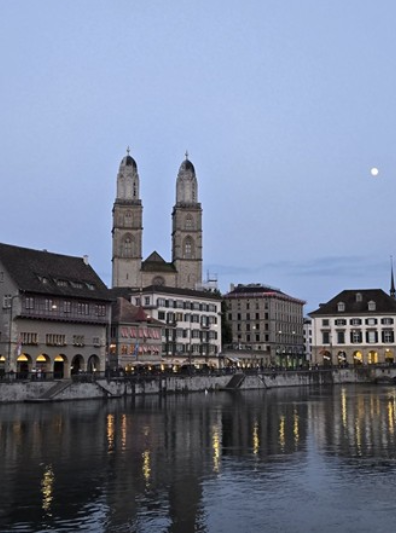
Our first night in Zürich, we walked down to the Limmat River right around dusk and caught this view — the twin towers of Grossmünster cathedral rising above the old town, a full moon hanging above the skyline, the whole thing reflected in the still water below. It stopped us in our tracks.
Zürich has a reputation as a finance city, which is fair — but the old town (Altstadt) is genuinely lovely to wander. Narrow lanes, guild buildings from the 1600s, waterfront cafés, and church towers everywhere. Spend your first evening just walking. Skip the expensive restaurants and grab a beer at one of the spots right on the river.
✈ Grossmünster is free to enter and worth going inside. The crypt dates to the 11th century.
Bern — Fountains, Flags & Cobblestones
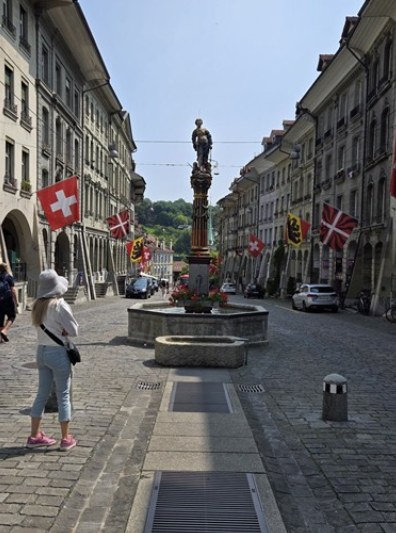
Bern is Switzerland’s capital, and it feels nothing like a capital city — in the best way. The old town is a UNESCO World Heritage site, and walking through it feels like stepping onto a movie set. Six kilometers of covered arcades run through the city center so you’re never caught in the rain.
The ornate fountains scattered throughout the old town are one of Bern’s signatures — each topped with a painted medieval figure, standing since the 1500s. The Swiss flags lining every street just added to the effect. This is one of those places where you put your phone down and just look.
✈ The Bear Park (Bern means “bear”) is free and right by the old town. Real bears. Really cute.
Lauterbrunnen — The Valley That Doesn’t Feel Real
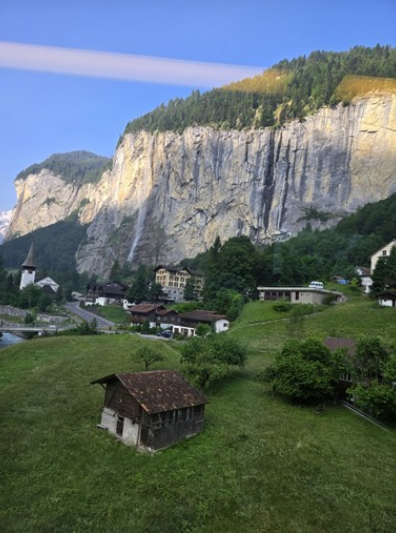
If you’ve ever seen a photo of a Swiss village tucked into a sheer cliff valley with waterfalls streaming down the rock face, it was probably Lauterbrunnen. Seventy-two waterfalls pour into this valley. Seventy-two. You can see three or four at once just standing in the middle of town.
This shot was taken early morning — golden light just catching the top of the cliffs while the village below was still quiet. The Staubbach Falls drops nearly 300 meters straight down. It’s the kind of view that makes you question why you live anywhere else.
✈ Lauterbrunnen is the base for day trips to Jungfraujoch, Grindelwald, and Mürren. Stay here instead of Interlaken if you want to be closer to the mountains.
Jungfraujoch — Top of Europe
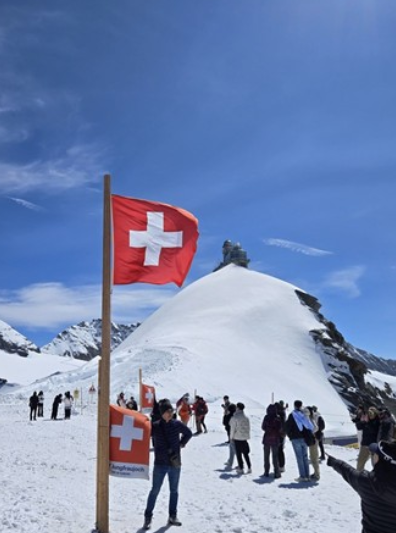
At 3,454 meters (11,332 feet), Jungfraujoch is the highest railway station in Europe. Getting there takes about two hours by train from Lauterbrunnen — through tunnels carved straight into the mountain — and when the doors open at the top, you walk out into another world entirely.
Snow, ice, glaciers, Swiss flags snapping in the wind, and views across the Alps that stretch into four countries. Even in June, it was well below freezing. The UV intensity at altitude means sunscreen is non-negotiable.
✈ Book Jungfraujoch tickets well in advance, especially in summer. The early “Good Morning” train is cheaper and the mountain is usually clearer before noon.
Lake Brienz — That Color Isn’t a Filter
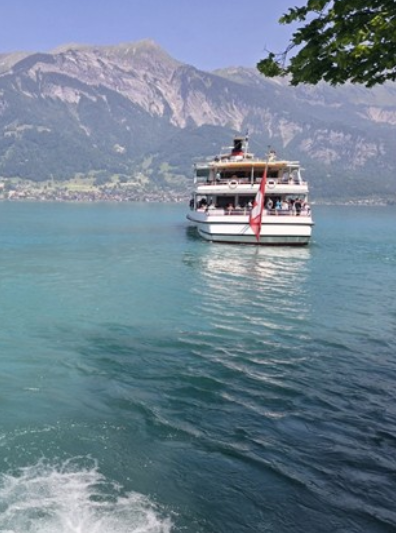
Lake Brienz near Interlaken has water so intensely turquoise that every photo looks edited. It’s not. The color comes from glacial meltwater carrying fine rock particles that scatter light in a way that produces that impossible blue-green. Science — but also just really, really beautiful.
The boat service on Lake Brienz is part of the Swiss Travel Pass, so hop on and ride to the village of Brienz on the far end. It’s a great half-day loop with the Alps stacked up behind you the whole way.
✈ The Giessbach Falls on the south shore are accessible by a short funicular ride and absolutely worth the stop.
The Gondola Ride — When the View Does All the Work
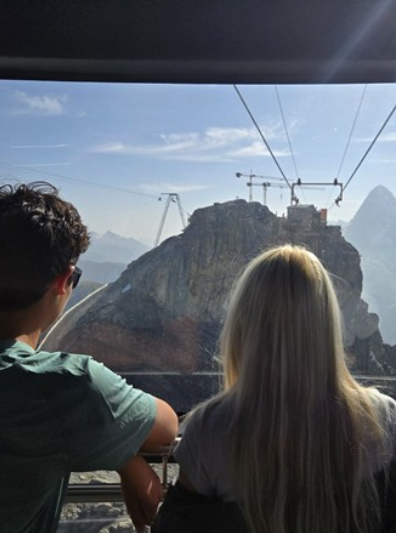
There’s something about watching mountains get closer through a cable car window that never gets old. The Eiger’s north face visible to the right, the gondola station above still being built out, the whole landscape looking like it was rendered by someone with no interest in being subtle.
Switzerland has an extraordinary network of cable cars, gondolas, and mountain railways — many included with the Swiss Travel Pass or a regional pass. Go up as many as you can. Each one offers a completely different perspective on the Alps.
✈ Schilthorn, Männlichen, and First above Grindelwald all have great gondola access and incredible summit views. Mix and match based on the day’s weather forecast.
Lucerne — The Lion Monument

Mark Twain called it “the most mournful and moving piece of stone in the world.” The Lion Monument in Lucerne is carved directly into a sandstone cliff face, tucked into a garden so peaceful and shaded that you’d almost walk past it if you didn’t know it was there.
The lion is dying — spear broken, shield beside him — carved in 1821 to honor the Swiss Guards massacred during the French Revolution. Even in a city full of beautiful things — Chapel Bridge, the old town, Lake Lucerne right there — this stopped us completely.
✈ Lucerne is an easy day trip from Zürich or a great final stop on a Swiss loop. The old town and Chapel Bridge are completely walkable and car-free.
Final Thoughts: Should You Go to Switzerland?
Yes. Unequivocally yes. Switzerland is expensive — we won’t pretend otherwise — but the experience is genuinely hard to beat anywhere in the world. The trains run perfectly, the country is safe and easy to navigate, and every single turn seems to offer another view that doesn’t look like it should exist in real life.
Go for at least ten days if you can. Hit the cities and the mountains. Take the slow trains. Sit by a lake. Bring a bigger memory card than you think you’ll need.